


Different types of business administration can lead to very different careers, and very different paychecks. A finance path can lead to a six-figure salary. An HR path can lead to a career built around people. The right pick depends on what you enjoy and where the jobs are headed.
Here is why it is worth the effort. Business and financial jobs earned a median of $80,920 a year in May 2024, according to the U.S. Bureau of Labor Statistics (BLS). The median for all U.S. jobs was $49,500. That is a gap of more than $31,000.
In this guide, we break down ten paths in plain English, with real pay and growth numbers for each.
What Is Business Administration?
Business administration is the work of keeping a company running. It covers money, people, sales, systems, and day-to-day decisions.
Think of a company as a car. Business administration is the whole dashboard. Some people watch the fuel gauge (finance). Others handle the passengers (HR) or the route (operations). Each one is a different type of business administration, and each one has its own career path.
Different Types of Business Administration by Degree Level
Before you pick a specialty, you pick a level. Here is a quick look at the four main ones.
| Level | Typical length | Best for |
|---|---|---|
| Associate | About 2 years | Entry-level jobs, or a low-cost start before transferring |
| Bachelor’s (BBA, BSBA, or BABA) | About 4 years | The most common route into business roles |
| MBA | Usually 1 to 2 years after a bachelor’s | Moving into leadership, often with some work experience |
| Doctorate (DBA or PhD) | About 3 to 5 years | Teaching, research, or senior consulting |
Most people start with a bachelor’s degree and choose a specialty during it. That specialty is where the money and job growth really differ.
The 10 Different Types of Business Administration by the Numbers
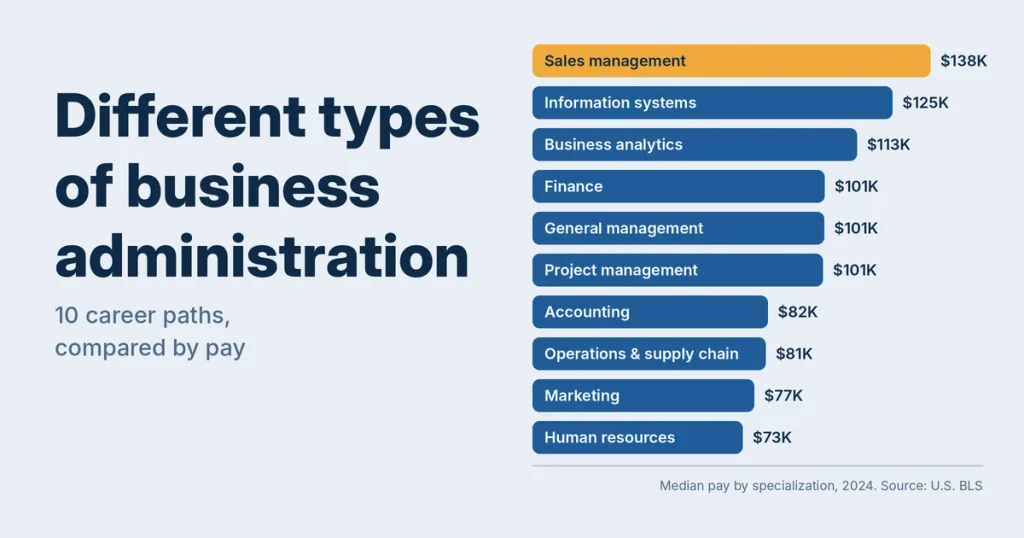
Here is the big picture. Each row shows a specialty, a common job it leads to, and what that job pays and how fast it is growing. Pay is the national median for May 2024. Growth is the BLS forecast for 2024 to 2034. For scale, jobs overall are expected to grow 3%.
| Specialization | Example job | Median pay (2024) | Job growth (2024-34) |
|---|---|---|---|
| General management | Management analyst | $101,190 | 9% |
| Finance | Financial analyst | $101,350 | 6% |
| Accounting | Accountant or auditor | $81,680 | 5% |
| Business analytics | Data scientist | $112,590 | 34% |
| Information systems | Information security analyst | $124,910 | 29% |
| Marketing | Market research analyst | $76,950 | 7% |
| Human resources | HR specialist | $72,910 | 6% |
| Sales management | Sales manager | $138,060 | 5% |
| Operations and supply chain | Logistician | $80,880 | 17% |
| Project management | Project management specialist | $100,750 | 6% |
Notice something? Every row beats the $49,500 median for all jobs. Even the lowest, HR at $72,910, is about 47% higher. The numbers come from the BLS, as summarized by the College of Southern Maryland, plus the BLS pages for information security analysts, market research analysts, and HR specialists.
Now let’s look at each one.
Different Types of Business Administration for People Who Like Numbers
If you enjoy spreadsheets, patterns, and puzzles, these four paths fit you.
1. Finance. Finance is about growing and protecting money. Financial analysts earn a median of $101,350. The big prize comes later. Financial managers earn a median of $161,700, and that job is expected to grow 15% by 2034, according to BLS data. Those roles usually take years of experience on top of the degree.
2. Accounting. Accountants and auditors earn $81,680 and have steady demand, with about 124,200 openings each year. Growth is slower at 5%, so expect stability more than rapid change.
3. Business analytics. This path turns data into decisions. Data scientists earn $112,590, and that job is expected to grow 34%. That is more than ten times the 3% average for all jobs.
4. Information systems. This path blends business with technology. Information security analysts earn $124,910 and face 29% growth, one of the fastest rates on the list.
Different Types of Business Administration for People Who Like People
If you enjoy talking, persuading, and leading, look here.
5. Human resources. HR specialists hire, train, and support employees. They earn a median of $72,910, with about 81,800 openings a year. That is the lowest pay on our list, but it also comes with plenty of jobs.
6. Marketing. Marketers figure out what customers want. Market research analysts earn $76,950, and the field is growing 7%.
7. Sales management. This path is the best-paid people role on the list. Sales managers earn a median of $138,060. Growth is a modest 5%, so competition for top roles can be tough.
8. General management. This path suits people who want a broad view of the business. Management analysts, who advise companies on how to work better, earn $101,190 and have about 98,100 openings each year.
Different Types of Business Administration for People Who Like Building Things
If you like making plans and watching them come together, try these.
9. Operations and supply chain. This path keeps products moving from factory to customer. Logisticians earn $80,880, and their field is growing 17%, among the best rates here outside tech.
10. Project management. Project managers keep teams on time and on budget. Project management specialists earn $100,750, with about 78,200 openings a year, across fields like construction, tech, and healthcare.
Two more paths are worth a look: entrepreneurship and international business. The BLS does not track pay for them in the same way, since entrepreneurs often work for themselves. But they are popular add-ons, especially if you want to start a company or work abroad.

Which Types Pay the Most, and Which Are Growing Fastest?
Here is the short version of the table above.
- Highest pay: Sales management ($138,060) and information systems ($124,910). Financial managers top both at $161,700, but that comes after years of experience.
- Fastest growth: Business analytics (34%), information systems (29%), and operations and supply chain (17%).
- Slowest growth: Accounting and sales management (both 5%). They still pay well, but openings grow slower.
One warning. These are national medians. Half of workers earn more and half earn less, and your city, employer, and experience will move the number.
How to Pick From the Different Types of Business Administration
You do not have to decide on day one. Try this simple plan.
- Start broad. Take general business classes first and see what clicks.
- Match your strengths. Numbers, people, or planning? Use the three groups above.
- Check real job ads. Search for entry-level jobs in each path and see what employers want.
- Compare the table. Weigh pay against growth, not just one or the other.
- Try it out. An internship tells you more than a brochure ever will.
Frequently Asked Questions
What are the different types of business administration?
There are two ways to slice it. By degree level, they are associate, bachelor’s, MBA, and doctorate. By specialty, common choices include finance, accounting, marketing, human resources, operations, project management, analytics, and information systems.
Which type of business administration pays the most?
Among the paths in this guide, sales management and information systems lead on median pay, at $138,060 and $124,910. Financial managers earn even more, at $161,700, but those jobs usually need years of experience.
Which type is growing the fastest?
Business analytics, with 34% projected growth from 2024 to 2034. Information systems and operations and supply chain follow at 29% and 17%.
Is business administration the same as business management?
They overlap a lot. In general, administration leans toward running day-to-day operations and systems, while management leans toward leading people and teams. Many schools use the two names for similar degrees.
What is the best specialty for beginners?
If you are unsure, a general business or management track keeps your options open. You can add a specialty later.
Final Thoughts
The different types of business administration all pay better than the average U.S. job, but they are not equal. Analytics and information systems are growing the fastest. Sales management and finance pay the most at the top. HR, marketing, and operations offer a lot of steady openings.
The best choice is the one that fits how you like to work and where the jobs are headed. Use the table, test a few paths, and pick the one you can see yourself doing for years.